We are in the thick of favorable conditions for several foliar and soilborne diseases on tomato and pepper, but, fortunately, late blight isn’t one of them. It has been too hot and sunny in Mills River to favor conditions for that disease to spread, if it were present in the region. Thus far, no reports of late blight on tomato have been made along the eastern seaboard. Historically, this disease often appears after a cool and rainy spell in August or September. If we get a cool and rainy period, growers should diligently scout and contact your local agent or myself if a case is suspected.
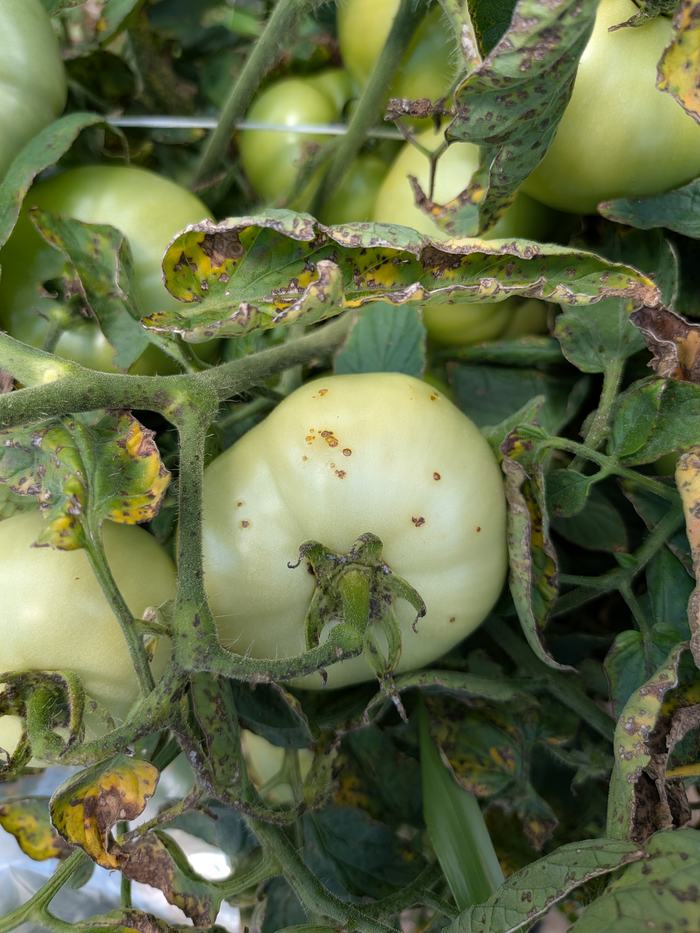
The heat and frequent rainfall events have really ramped up pressure for bacterial leaf spot, early blight, and bacterial wilt on tomato. While I know that some of you are having a difficult time getting into the field to spray, if you can, time sprays so that they fully dry on the tissue (allow at least 2 hours before anticipated rain). There is limited data on how long fungicide residue persists on leaf tissue after rainfall, but data that does exist suggests that chlorothalonil has better sticking power after rain than mancozeb. So, if you are at the stage in your crop where you can switch to chlorothalonil, now is a good time. If you’re applying mancozeb, consider re-applying after ~1.5” of total rainfall. If you are following the 2026 tomato spray program, you will be in the habit of including a single-site fungicide for control of early blight/Septoria leaf spot every ~14 days. Under conditions of high pressure (frequent rainfall events, warm temperatures), you can tighten that interval to 7 days if the label allows and if you are rotating active ingredients.
This year in Mills River we are evaluating several grower spray programs for control of bacterial leaf spot and early blight. We chose programs based on average cost, and we are excited to share the final data with you once the trial is complete. Early, numerical data from this trial suggests that Cabrio alternated every 14 days with Fontelis or Miravis Prime is providing stronger control of early blight on tomato than Quadris alternated with Endura.
We are beginning to survey irrigation water for Phytophthora capsici, the causal agent of Phytophthora crown rot and blight on peppers and cucurbits, with the objective of detecting its presence in irrigation sources and studying water treatments that eliminate it. If you irrigate using surface water (pond, river, or creek) and would like us to test your water, please call, text, or email me at (540) 577-8607 or ereeves2@ncsu.edu.