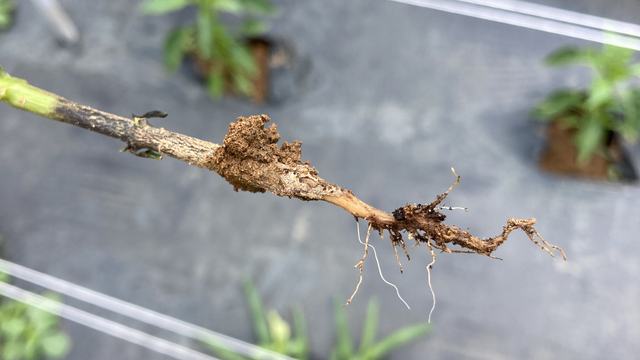
Summer is in full swing in Mills River with highs approaching the upper 80s and daily thunderstorms. As expected, we’ve started to see a few cases of Phytophthora on pepper so I figure now is as good a time as any to dive into that disease a little bit.
Phytophthora root and crown rot, and aerial blight on pepper or cucurbits is caused by Phytophthora capsici. This pathogen is different from the Phytophthora that causes late blight on tomato (Phytophthora infestans). Several key facts about the pathogen that have implications for management are listed below.
- The pathogen mainly causes disease on peppers and cucurbits. It can infect tomato under ideal conditions (excessive soil moisture, hight pathogen population, temperatures between 75-90°F) but disease on tomato caused by this organism is rare.
- Infection is most often initiated in the root and crown tissue, or sometimes fruit in the case of cucurbits. Aerial dispersion of the pathogen occurs under conditions of severe crown and/or fruit infection with rainfall events and high humidity. This pathogen can survive in the soil in the absence of plant debris for 5+ years if certain strains are present.
- Dispersion via contaminated irrigation water (it can survive in ponds, ditches, and rivers) or the movement of infested soil is the most common means of transmission. The pathogen is not transmitted on seed, over long distances aerially, or by insects.
Infection by the pathogen occurs days before symptoms of wilting and crown rot appear, so proactive management is key.
If you are planting in a field with a history of the disease, management should include planting resistant/tolerant cultivars, following a fungicide application schedule where 3 products are rotated, and ensuring that irrigation water is free from the pathogen.
Although it’s a bit late this year to talk about cultivar selection, there are good resistance packages in pepper, but not so much for summer squash or cucumber, and I’m honestly unsure of how the pumpkin resistance holds up as this has not been evaluated recently in NC to my knowledge.
If you navigate to pages 110 (pepper) and 117 (pumpkins/winter squash) in the 2026 vegetable crops handbook you can find the resistance tables.
Trials in Mills River over several years demonstrated that applying a fungicide at planting via drench followed by a foliar spray program for Phytophthora on pepper was the best strategy to control this disease. Options to apply at transplant via chemigation (or for some, in transplant water) include Ridomil Gold, Orondis Gold, Presidio, Ranman, or Elumin. Begin foliar spray applications of Presidio, Ranman, Revus, or Orondis Ultra 10 to 14 days after transplant if conditions are favorable for the disease (frequent rainfall events and daytime averages above 80°F). Foliar applications should include copper in the tank mix and a minimum of two products should be rotated on a 10 to 14 day interval. In trials in Mills River, Revus alternated with Ranman provided great control of Phytophthora blight on pepper.
Give us a call if you think that you’re seeing any of these products fail to control Phytophthora.
As far as irrigation water is concerned, this is an area that needs more study. If you can irrigate out of a well, that’s ideal for this disease. If your irrigation water is coming out of a river but you’re using sand filtration, the sand filtration should be removing the pathogen but this is based on studies done elsewhere. It is our understanding that many of you are required to inject irrigation water with SaniDate, but the effect of SaniDate on the pathogen in irrigation water has not been studied to the best of our knowledge. If you suspect that irrigation water out of a river or pond contains the pathogen after filtration, call us and that’s something that we can test.
I’ll be out on vacation for two weeks beginning on Monday, 6/15, so please contact Sara Villani if you need something.